
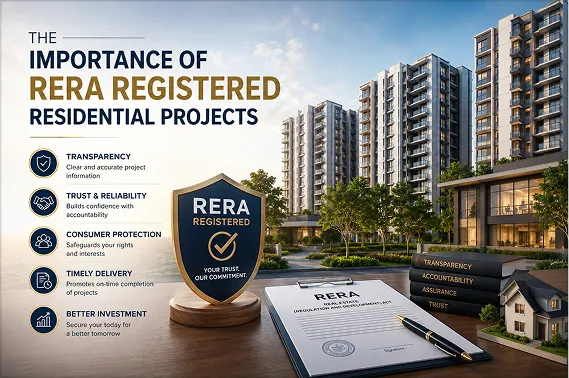
Importance of RERA Registered Residential Projects
The Real Estate (Regulation and Development) Act, commonly known as RERA, represents one of the most significant and positive transformations in India's real estate sector in recent history. Enacted in 2016 and progressively implemented across Indian states, RERA fundamentally changed the relationship between homebuyers and developers — shifting power toward buyers, mandating unprecedented levels of transparency, and creating a robust accountability framework that protects homebuyers' interests at every stage of the property purchase journey.
Before RERA, the real estate market in India operated in an environment where developers held most of the informational and legal advantages. Buyers often had to rely on developers' marketing materials for key project information, had limited legal recourse in cases of delays or quality failures, and frequently encountered hidden charges, misleading specifications, and unilateral changes to project terms. RERA changed all of this, and for buyers today, investing in a RERA-registered project like Indraprasth Saptak is one of the most important forms of protection available in the market.
Transparency in Information – Complete Clarity Before You Commit
One of RERA's most powerful provisions is its requirement for comprehensive, standardized information disclosure by developers before a project can be marketed or sold. When a project is registered with RERA, the developer must publish detailed information on the state RERA portal, where it is accessible to any interested buyer at any time. This information covers the complete project details including layout plans, floor plans, and structural specifications; the exact carpet area of each unit type expressed in the standardized RERA definition; the names and qualifications of the architects, engineers, and contractors involved in the project; all regulatory approvals already obtained and those still pending; the phased development schedule with specific delivery milestones for each phase; and the quarterly construction update reports that developers must file throughout the project's lifecycle.
This level of disclosure means that buyers are no longer dependent on developers' sales teams for information that could be biased or incomplete. Projects like Indraprasth Saptak ensure that buyers have complete clarity on every important aspect of their purchase before making a commitment — creating a genuinely informed decision-making environment that respects buyers' intelligence and financial stakes.
Protection Against Delays – Accountability That Has Real Teeth
Project delays were arguably the single most significant pain point for Indian homebuyers in the pre-RERA era. Stories of projects delayed by several years — sometimes indefinitely — were unfortunately common, leaving buyers locked into EMI payments on home loans while continuing to pay rent, with little legal recourse against developers who missed deadline after deadline.
RERA addresses this issue with clear, enforceable provisions. Developers must commit to a specific project completion date at the time of registration, and any changes to this date require prior approval from the RERA authority. If a developer fails to deliver possession by the committed date for any reason other than force majeure events specifically defined under the Act, the buyer has the right to either withdraw from the project and receive a full refund of all amounts paid with interest, or to continue with the project and receive compensation for the delay period in the form of interest on all amounts paid.
This provision transforms the economics of delays for developers, making timely delivery a genuine financial priority rather than just a marketing promise. For buyers investing in RERA-registered projects like Indraprasth Saptak, the delay protection provisions provide meaningful financial security and the peace of mind that comes from knowing their rights are clearly defined and legally enforceable.
Legal Security – Protection From the Full Spectrum of Unfair Practices
Beyond transparency and delay protection, RERA provides homebuyers with legal protection against a wide range of unfair practices that were previously common in the unregulated market. Misleading advertisements — brochures or presentations that show amenities, views, or specifications that are not actually part of the sanctioned project — are prohibited under RERA, and developers can be penalized for making representations that are not consistent with the registered project details.
Hidden charges are another category of unfair practice that RERA addresses directly. Developers cannot levy charges for amenities, infrastructure, or services that were not disclosed at the time of the original agreement. The total price payable by a buyer must be fully transparent and consistent with the registered project information. False commitments — promises made during the sales process that are not reflected in the formal agreement — are not enforceable and cannot be used to create additional obligations for buyers. RERA gives buyers the confidence to rely on what is in the registered documents, not just what is said across a sales table.
Standardized Processes – Consistency and Verifiability
RERA creates a standardized framework for real estate transactions that brings consistency, predictability, and verifiability to a market that previously operated with significant variation in documentation standards and contractual practices. All project details, developer credentials, financial statements, and construction updates are available on publicly accessible state RERA portals, allowing buyers to independently verify any information provided by a developer's sales team.
The standardized agreement for sale template mandated under RERA ensures that key terms of the transaction — the exact specification of what is being purchased, the payment schedule, the possession date, the developer's obligations, and the buyer's rights — are clearly expressed in a legally consistent format. This standardization makes it significantly easier for buyers to compare projects, understand their rights, and seek legal recourse if needed.
The RERA Grievance Redressal mechanism provides buyers with an accessible, relatively low-cost forum for resolving disputes with developers — far quicker and less expensive than traditional civil litigation. This mechanism means that buyers are not deterred from asserting their rights by the prospect of protracted and costly legal proceedings.
Quality Assurance – Structural Integrity Over the Long Term
RERA's protections extend beyond the purchase and possession stages to cover the long-term quality and structural integrity of what has been built. Under the Act, developers are required to rectify any structural defects in the building that are reported by residents within five years of possession, at no additional cost to the buyer. This provision creates a powerful incentive for developers to invest in quality construction from the very beginning, knowing that shortcuts taken during construction may result in costly rectification obligations after handover.
This defect liability provision is particularly important in a market where the quality of materials and construction practices can vary significantly between developers. For buyers choosing RERA-registered projects like Indraprasth Saptak, it provides the confidence that any structural issues discovered within the liability period will be addressed by the developer — protecting both the safety and the long-term value of their investment.
Why RERA Registration Matters Especially in Ahmedabad
Ahmedabad's real estate market has grown rapidly over the past decade, attracting buyers and investors from across Gujarat and beyond. This growth has been accompanied by a significant increase in the number of developers and projects, making it all the more important for buyers to have reliable frameworks for evaluating the trustworthiness of projects and developers.
Gujarat RERA (GujRERA) has been one of the more active and effective RERA implementations in India, with a substantial number of registered projects and a functioning grievance redressal system. For buyers in Ahmedabad, checking GujRERA registration is a simple but essential first step in evaluating any property purchase. It provides immediate access to key project information, gives confidence that the developer has met minimum disclosure standards, and ensures that the buyer's legal protections under RERA apply to the transaction.
Conclusion
Investing in a RERA-registered project is not just a legal formality — it is a fundamental decision that shapes the security, transparency, and peace of mind of the entire home-buying experience. RERA registration provides buyers with the information they need to make genuinely informed decisions, the legal protections they need to guard their investment against delays and unfair practices, the quality assurances they need to have confidence in what they are buying, and the dispute resolution mechanisms they need to assert their rights efficiently if problems arise. Developments like Indraprasth Saptak reflect a deep commitment to transparency, accountability, and trust — values that are embodied in RERA compliance but go far beyond it into every aspect of how the project is designed, built, and delivered. For every homebuyer in Ahmedabad, RERA registration should be the starting point of every property evaluation — not an afterthought.
